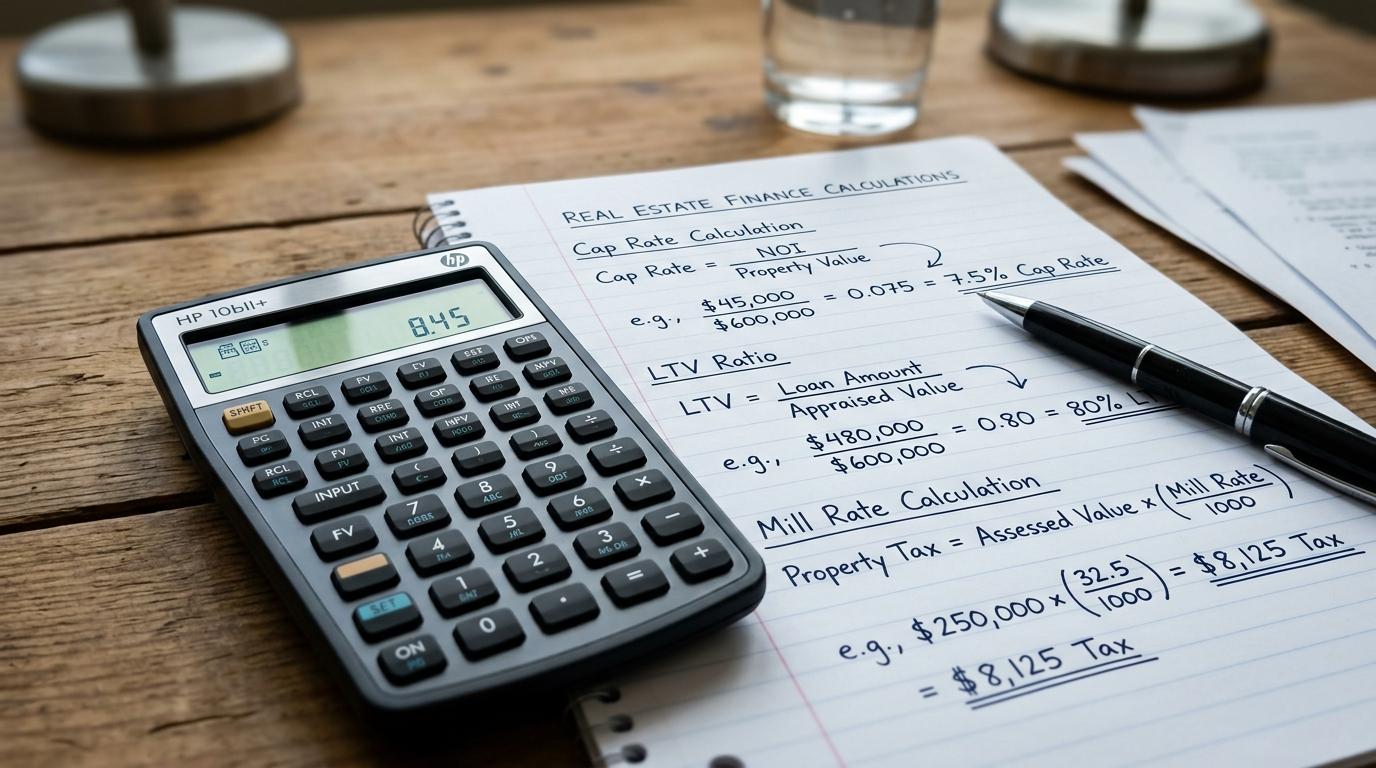
Formula 1: Capitalization Rate (Cap Rate)
Cap rate measures the rate of return on an investment property based on its Net Operating Income (NOI).
To find the NOI: Gross Rental Income − Vacancy Losses − Operating Expenses (Note: mortgage principal and interest are *never* operating expenses).
Calculation Example: An apartment building has a market value of $500,000 and generates $40,000 in Net Operating Income annually.
Formula: $40,000 / $500,000 = 0.08, or an **8% Cap Rate**.
Formula 2: Millage Rates & Property Taxes
Property taxes are calculated using assessed value (which is a percentage of market value) and millage rates. One mill equals $0.001 (or $1 of tax per $1,000 of assessed value).
Calculation Example: A property has a market value of $300,000. The assessment rate is 60% of market value, and the tax rate is 25 mills.
Step 1 (Assessed Value): $300,000 × 0.60 = $180,000.
Step 2 (Tax): $180,000 × (25 / 1,000) = $180,000 × 0.025 = **$4,500**.
Formula 3: Acreage and Square Footage
You must memorize the conversion constant: **1 Acre = 43,560 square feet**.
Calculation Example: A rectangular commercial parcel of land measures 300 feet wide by 435.6 feet long. How many acres is the parcel?
Step 1 (Area): 300 ft × 435.6 ft = 130,680 sq ft.
Step 2 (Acreage): 130,680 sq ft / 43,560 = **3.0 Acres**.
Formula 4: Loan-to-Value (LTV) Ratio
Lenders use LTV to measure loan risk. It compares the mortgage loan amount to the lower of the sale price or appraised value.
Calculation Example: A buyer purchases a home appraised at $400,000. They pay a $80,000 down payment and finance $320,000.
Calculation: $320,000 / $400,000 = 0.80, or an **80% LTV**.